An AI that works your federal bids while you sleep.
You tell it which federal bids you're chasing, in a sentence, and it keeps working while you sleep. It reads the whole package — the attachments, not just the notice — scores your real chance against the incumbent's award history, drafts from your own past performance, and checks the Section L rules. Nothing reaches a contracting officer without your click.
Read, score and draft everything for 7 days. Submitting and exporting are the paid part — that's the only thing held back.
Janitorial / grounds — VA, MD, under $2M
Runs weekdays 06:00 · reads attachments · scores PWIN · drops NO-GO before you see it
Reconstructed from real product behaviour. Timestamps are illustrative; the mechanism is not.
In short
- GovDealAI is an AI agent for US federal contractors that reads every solicitation in full — including the attachments — scores the opportunity against the incumbent’s award history, drafts the proposal from your own past performance, and verifies the submission against Section L before anything is sent.
- It works unprompted on a schedule: you give it a standing instruction in one sentence and it runs every weekday at 06:00.
- It never transmits a submission on its own. Every submission requires a fresh human click.
- It costs $350 a month and includes 10 proposal generations a month. The price is published; there is no sales call.
- The 7-day trial needs no card and does everything except submit and export.
The status quo
40–60 hours per bid. And most of them were decided before they posted.
40–60
Hours a small contractor spends assembling one or two bid submissions.
Practitioner, r/govcon100–200
Pages in a typical RFQ package that need reading thoroughly.
Practitioner, r/govcon3 of 4
Prior awards on a requirement going to the same firm — often with a single offer each cycle. That is visible before you spend the week.
Federal award recordsFour claims a wrapper cannot make
Every one of them is checkable.
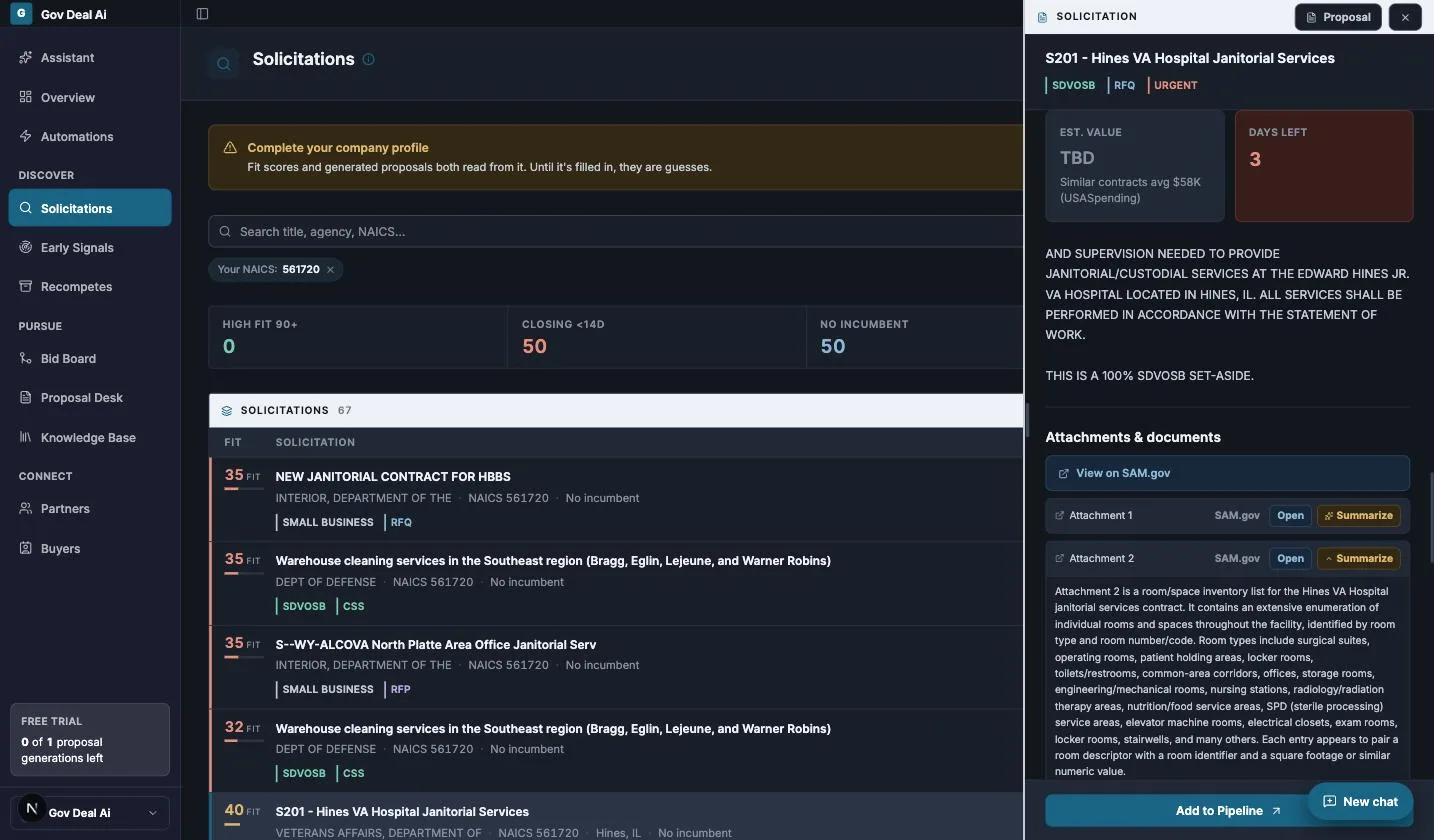
It reads the attachments, not just the notice.
The notice is a paragraph. The requirement lives in the PWS, the wage determination, the Section L instructions and the eleven amendments. It reads all of them, per attachment, and pulls out what actually binds you.
“ChatGPT often hallucinates requirements or misses the boring ones in 80+ page docs.”r/govcon
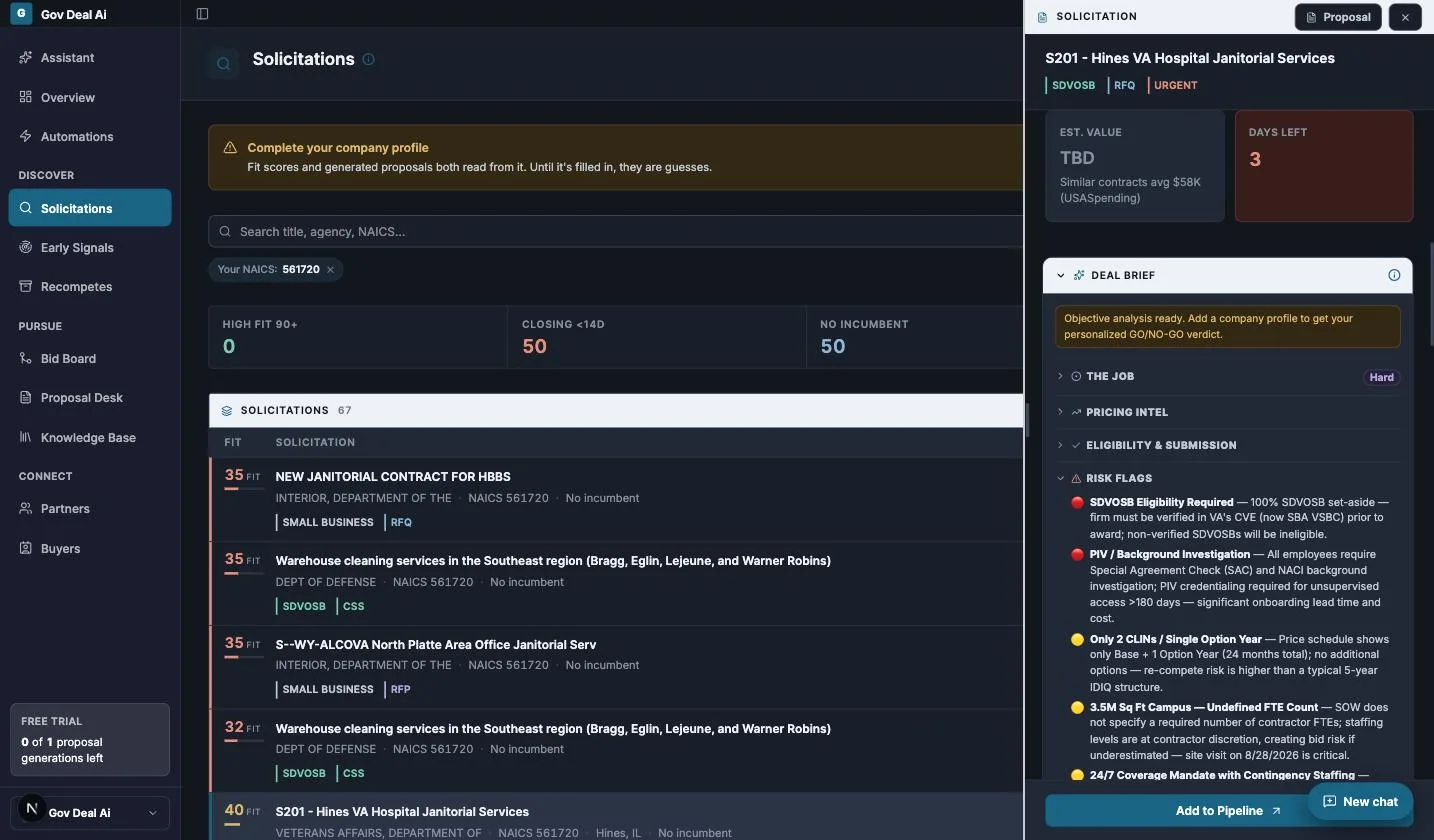
It tells you when a solicitation is wired for the incumbent.
Who won it last time, how many offers there were, what they were paid, and whether the requirement has drifted. SAM.gov does not show you that. The award record does.
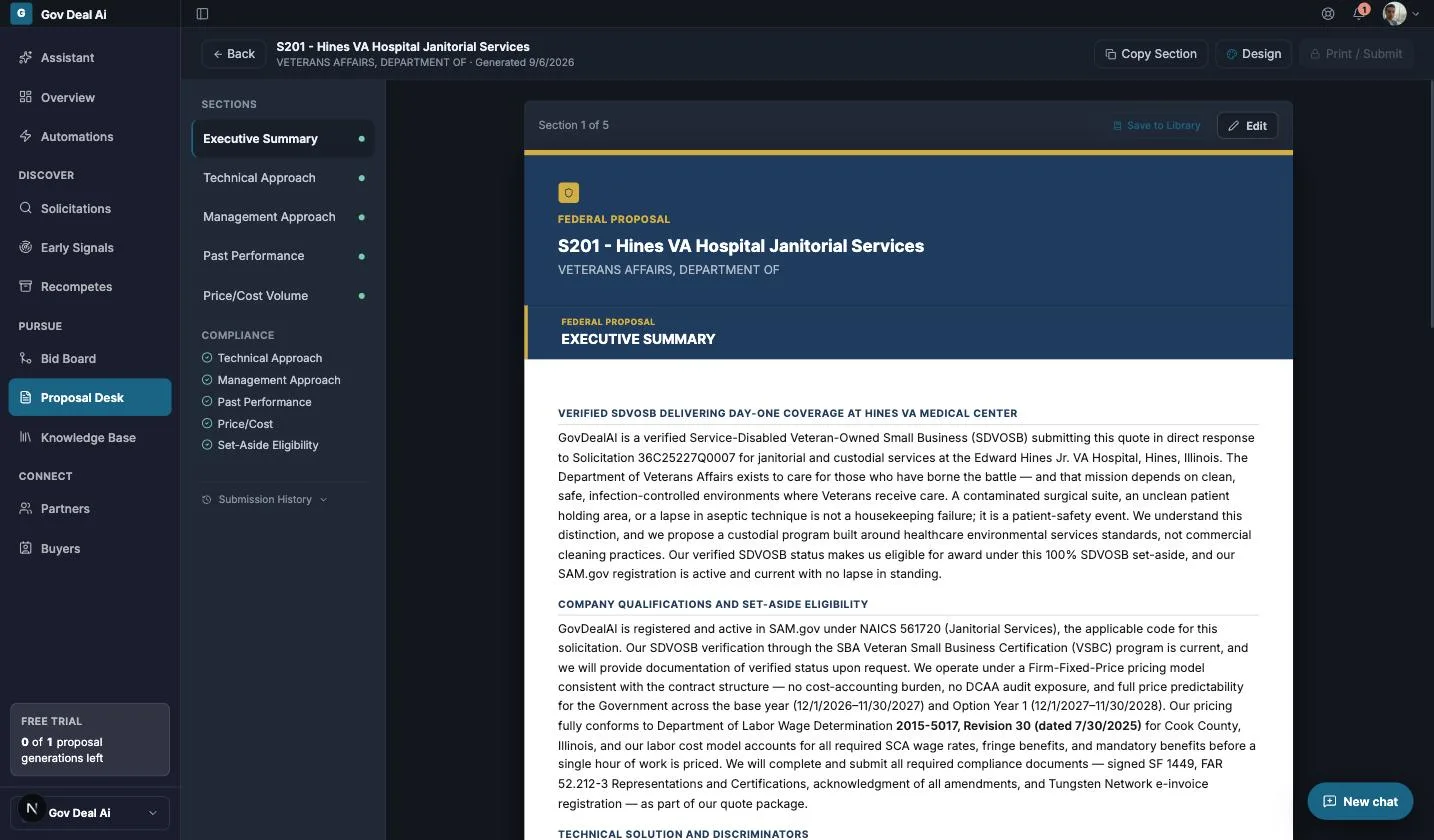
It drafts from your own past performance — then makes you edit it.
A raw AI draft loses, and contracting officers say so out loud. So every draft runs pink, red and gold team review, a compliance matrix, and a written/empty dot on every section before anything reads “ready”. The human in the loop is the feature, not the caveat.
“It's very easy to tell when something was generated without a real understanding of the requirement. Most COs can spot it instantly.”Contracting officer, r/govcon
Nothing goes out without your click — and Section L is checked first.
Six checks run before the send button is live. Nothing in the competitive set advertises this, because nothing in the competitive set has anywhere to send from. Open a check to see what it saves you from.
10 proposal generations a month. Beyond that, talk to us. Finding, reading and scoring are unmetered — the meter counts only the proposals the agent writes for you.
What the category charges
Not one of the enterprise tools publishes a number. We are not the cheap option — we are the same order of magnitude as tools that only find work, and we run the whole bid.
A finder stops at “here's a solicitation.” A writer starts at “here's the RFP, now brief me.” Spanning the whole run takes an agent — which is why nobody else spans it.
Finders find. Writers write.
Nothing else spans the run.
| Finders | Writers | GovDealAI | |
|---|---|---|---|
| Finds the solicitation | yes | no | yes |
| Reads every attachment | no | partly | yes |
| Incumbent award history | some | no | yes |
| Bid / no-bid score | no | no | yes |
| Drafts the proposal | no | yes | yes |
| From your past performance | no | some | yes |
| Compliance matrix | no | some | yes |
| Colour-team review | no | no | yes |
| Section L verification | no | no | yes |
| Submits — after your click | no | no | yes |
| Delivery tracking | no | no | yes |
| Price published | rarely | no | $350/mo |
| Sales call required | usually | always | never |
What it is not
The exclusions, before you find them yourself.
This costs us nothing and it is the fastest way to say we are not the thing you have been pitched six times this year.
- It does not write your technical approach for you. It drafts; you own it.
- It does not see solicitations under $250k that agencies are not required to post. A SAM-derived feed has that blind spot and so do we.
- It does not submit on its own. Every submission needs a fresh human click.
- It is not a chat box in front of SAM.gov search.
- There are no mobile apps yet. They are coming; they are not here.
Questions
The ones that actually get asked.
Worth reading first
Plain answers, no gate.
Give it one week and one solicitation.
Read, score and draft everything. Submitting and exporting are the paid part — that is the only thing held back.